
The story behind our name
Who was Imo?
A young Japanese macaque from Koshima Island whose single idea taught a whole community. Imosoft is named after her.
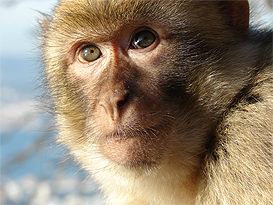
Japanese researchers observing several troops of Japanese macaques gathered surprising evidence of how well these monkeys can learn. One troop lives in the mountains of northern Japan, where winters bring deep snow. These monkeys once ventured into a part of the forest they had never explored before and came upon volcanic hot springs. A few of them tried the water, enjoyed the warm bath, and the habit soon spread through the whole troop: since then, all of them bathe every winter. The curiosity behind this discovery, and the flexibility with which they made the novelty part of their daily lives, show just how open these animals are to new things.
Even more remarkable things were observed in another troop, which lives on Koshima, a tiny island off the coast of Kyushu. A narrow strait with strong tidal currents separates the island from the mainland, so its monkeys live in near isolation. In 1952, Japanese primatologists, among them Kinji Imanishi, Masao Kawai and Shunzō Kawamura, began studying the group of just twenty animals. At first the monkeys were wild and wary, so the researchers scattered sweet potatoes to coax them into the open. A year later a young female, whom the researchers named Imo, did not eat the usual sandy, muddy tuber straight away: she carried it to a pool, dipped it in the water and rubbed the dirt off with her hand. Whether this was the result of deliberate thinking is impossible to say, but after that first attempt she did it regularly.
First a playmate and then her mother picked up the trick from her, and the habit spread through the troop by imitation. The researchers followed the process for ten years, until 1962. In the early years, up to 1958, youngsters between one and two and a half years old learned most easily, older animals less and less, and the older ones picked up the novelty from the young. Males older than four never adopted the habit, while some older females did learn it. Masao Kawai explained this by the place adult males hold in the group: they have little contact with the young and the females, so they have fewer chances to pick up a new trick. From 1959 the situation changed: youngsters born then saw their parents washing potatoes from a very early age, so almost all of them learned it. In time some began washing their potatoes in the sea instead of freshwater pools, perhaps because they liked the salty taste.
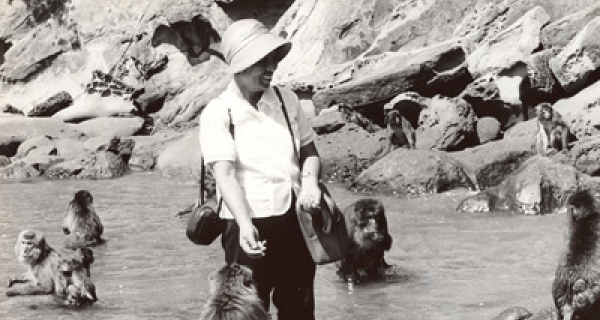
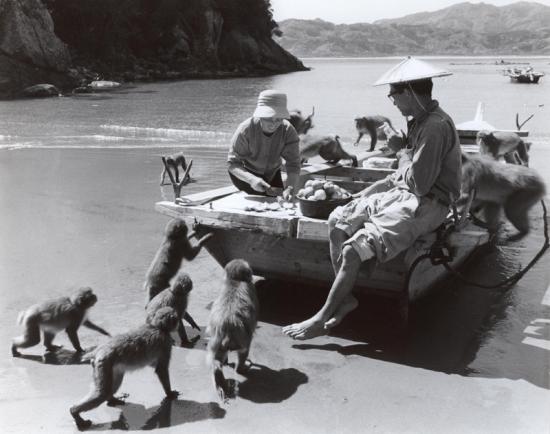
Imo later came up with another idea. The researchers also scattered unhusked rice on the beach and trod it into the sand, hoping the monkeys would spend a long time picking up the grains, leaving plenty of time to observe them. Imo, however, took a handful of sandy rice to the water and threw it in. The sand sank, while the grains of rice floated on the surface, where she could easily scoop them up. This method also spread quickly, and soon everyone gathered rice this way.
When the members of a community learn from one another and the knowledge they gain becomes a shared habit, that is the beginning of culture. We usually use this word only for human societies, but on Koshima we can see the phenomenon emerging in a simple, early form.
The feeding had one more consequence. These tough, aggressive little animals do not hesitate to use their strong teeth on each other, yet they are no longer at all afraid of people; in fact, when someone arrives with a sack of sweet potatoes, they try to steal from it. Since handing out the tubers one by one would be impractical, the researchers simply empty the sack onto the beach and step back. The monkeys rush at the pile: they grab one tuber in a hand, stuff another into their mouths and hobble off on three legs. Some, however, are cleverer: they clasp several tubers to their chests with both arms and run upright on two legs along the beach to a safe spot among the rocks.
Based on David Attenborough’s Life on Earth
-
1952
Researchers begin observing the Koshima macaques and coax them into the open with sweet potatoes.
-
1953
Imo washes the sandy tuber in water. This is the moment of discovery.
-
The following years
A companion, then her mother adopt the habit, and eventually almost the whole troop.
-
Later
Imo throws sandy rice into the water and gathers the grains floating on the surface. This trick, too, becomes common knowledge.
For the researchers, Imo became living proof that animals also learn from one another and pass on what they have learned. And that is nothing less than the seed of culture.
Imo and Imosoft
Behind the name
This idea is behind our name: a good idea is truly worth something when others can learn it too.
The emblem itself symbolises this: Imo leaves a mark.
Back to the home page